Communication Skills Every Student Needs for Future Competitive Exams
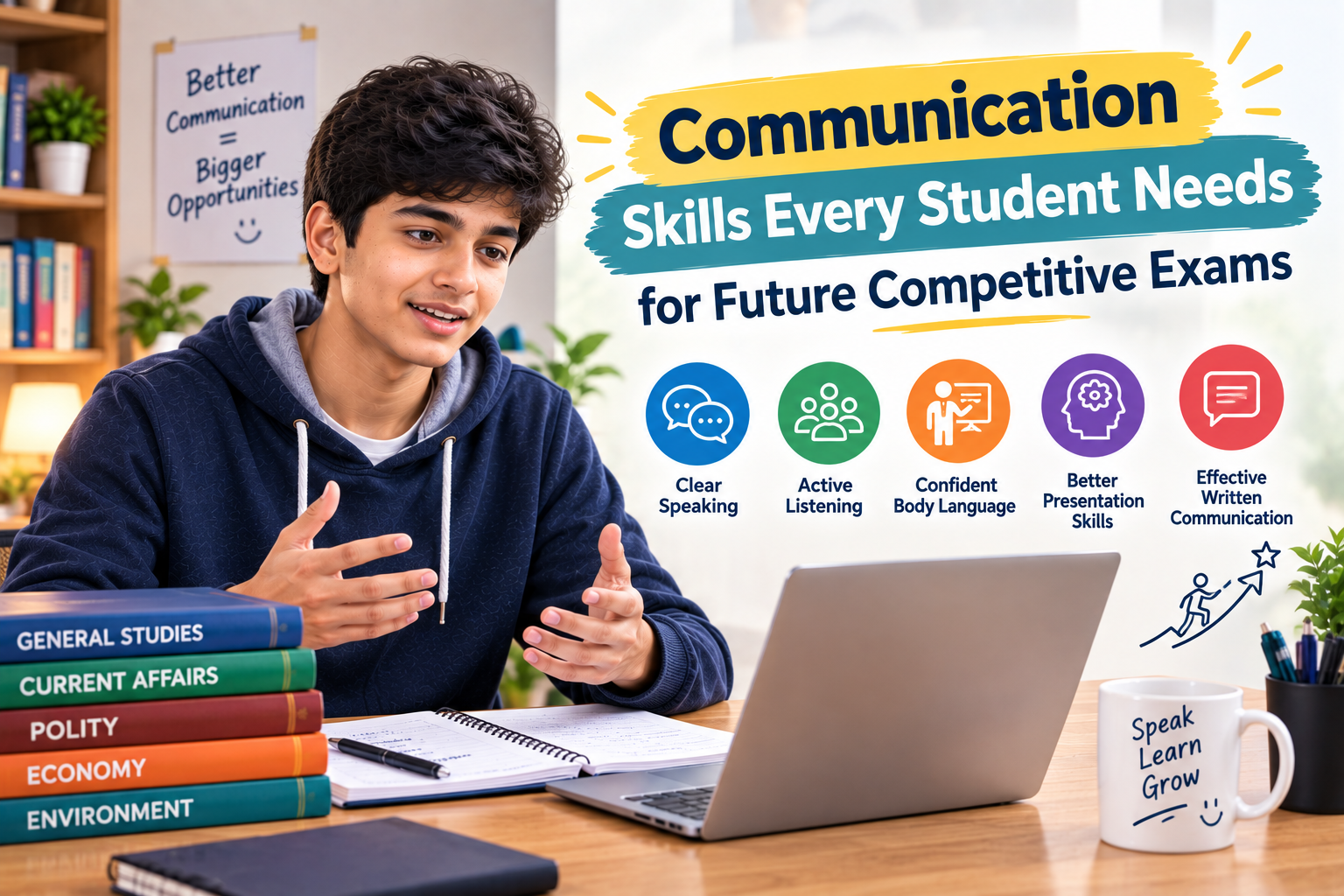
Communication is one of the most useful skills a student can develop. It affects how students participate in class, write answers, explain ideas, work with others and express their opinions. For students who may consider UPSC, KPSC or other competitive examinations in the future, communication becomes even more valuable because clear thinking must eventually be expressed clearly.
Good communication is not about using complicated English or speaking in a formal style. It is about understanding an idea and conveying it in a way that another person can understand. Students can begin developing this ability years before serious competitive-exam preparation begins.
Why Communication Matters for Students
A student may know the correct answer but struggle to explain it. Another student may have a good idea but hesitate to speak. These are communication challenges, and they can improve with practice.
Communication supports classroom learning, presentations, discussions, written assignments and teamwork. It also helps students listen to instructions, understand different viewpoints and ask useful questions.
For future competitive-exam aspirants, these habits can support writing, interviews, discussions and the ability to organise information logically.
The Four Core Communication Skills
Communication can be developed through four connected abilities: listening, speaking, reading and writing.
Listening helps students understand what another person is actually saying before responding. Speaking helps them express their ideas with confidence. Reading improves comprehension and gives students more ideas and vocabulary. Writing teaches them to organise thoughts in a structured form.
Students do not need to master all four at once. Small, regular activities can gradually improve each skill.
Develop Better Listening Habits
Good communication begins with listening. Students should learn to listen without immediately interrupting or preparing a response while the other person is speaking.
After a discussion, they can try to explain the other person's main point in their own words. This simple activity encourages attention and understanding.
Listening also teaches students that disagreement does not mean that another person's view should be ignored. Understanding a different perspective is an important part of mature communication.
Practise Speaking in Simple Situations
Students can start speaking practice with familiar topics. They might explain a school lesson, describe a book they read, talk about a current-affairs story or give a two-minute presentation on a topic they enjoy.
The goal should be clarity rather than perfection. Students should speak in their own words and organise their ideas before beginning.
A useful structure is simple: introduce the topic, explain two or three important points, give an example and conclude with the main idea.
Build Confidence Through Repetition
Confidence usually grows through repeated practice rather than through one-time encouragement. Students may feel nervous when speaking in front of others, especially at the beginning.
Teachers and parents can create opportunities for short presentations, discussions and classroom activities. Mistakes should be treated as part of learning.
Students can also practise speaking alone by explaining a topic aloud. Recording a short presentation and listening to it later can help them notice unclear sentences, repeated words or gaps in their explanation.
Improve Writing by Explaining Ideas
Writing does not have to begin with long essays. Students can start with short summaries, answers and reflections.
After reading a news story or learning a concept, they can write a few sentences explaining what they understood. They can gradually learn to organise an answer into an introduction, main points and conclusion.
The important principle is to write in their own words. Copying large sections from a source may produce a longer answer, but it does not necessarily demonstrate understanding.
Use Reading to Strengthen Communication
Reading provides students with ideas, vocabulary and examples that can improve both speaking and writing.
A student who regularly reads good-quality books, articles and newspapers becomes more familiar with different ways of explaining information. Reading also helps students understand how arguments are structured.
However, students should not try to memorise sophisticated vocabulary simply to sound impressive. Clear and appropriate language is more effective than unnecessarily complicated words.
Learn to Explain, Not Just Recite
One of the strongest signs of understanding is the ability to explain an idea simply.
Students can practise by choosing a topic and explaining it as though they are teaching it to someone who has never heard of it. If the explanation becomes confusing, they can identify the part they need to understand better.
This technique is useful for school subjects as well as future competitive-exam preparation.
Communication and Current Affairs
Current affairs provide excellent opportunities for communication practice. Students can choose one meaningful news story and discuss what happened, why it matters and who may be affected.
They can present their understanding in two or three minutes or write a short summary. If another student has a different opinion, they can practise responding respectfully.
This combines current-affairs awareness with speaking, listening and analytical thinking.
Debate Teaches Respectful Disagreement
Debate is another useful communication activity. Students learn to present an argument, listen to an opposing view and respond using reasons and examples.
A good debate is not about speaking the loudest or defeating another student personally. It teaches students to disagree with an idea while continuing to respect the person presenting it.
These habits can strengthen confidence, critical thinking, teamwork and leadership.
Communication Skills and Future UPSC/KPSC Preparation
Serious UPSC and KPSC preparation comes later, but communication skills can be developed much earlier.
Future aspirants need to understand information and eventually express their understanding through written answers and, where applicable, oral communication. A student who has already learned to organise ideas, listen carefully and speak clearly has developed useful foundations.
At school level, however, communication training should remain age-appropriate. Students should not be pressured to imitate formal interview candidates or memorise model answers. The aim is natural, confident and clear expression.
How Compass IAS Academy Builds Communication Skills
Compass IAS Academy's IAS @ School programme for Classes 8–12 includes public speaking, debate, discussions, reading, writing, current affairs, reasoning, analytical thinking, quizzes and mentoring.
These activities are designed as part of foundation learning rather than as premature full-time UPSC preparation. Students can develop communication and thinking skills while continuing their regular school education.
Parents and teachers can support the same process by giving students opportunities to speak, asking open-ended questions and providing constructive feedback.
Small Practice Can Create Long-Term Improvement
Students do not need a special occasion to practise communication. A two-minute explanation, a short written summary, a classroom presentation or a thoughtful discussion can become useful practice.
The most important habits are simple: listen before responding, organise ideas before speaking, use clear language, support opinions with reasons, write in your own words and learn from feedback.
Communication is not an extra skill that matters only in interviews or professional life. It supports learning itself. When students can explain what they know, ask better questions and understand other viewpoints, they become more effective learners.
For students considering future UPSC or KPSC preparation, building these habits early can make the journey more confident and structured. The goal is not perfect communication. It is steady improvement and the ability to express ideas with clarity, respect and confidence.