Critical Thinking for Competitive Exams: How Students Can Learn to Think Better
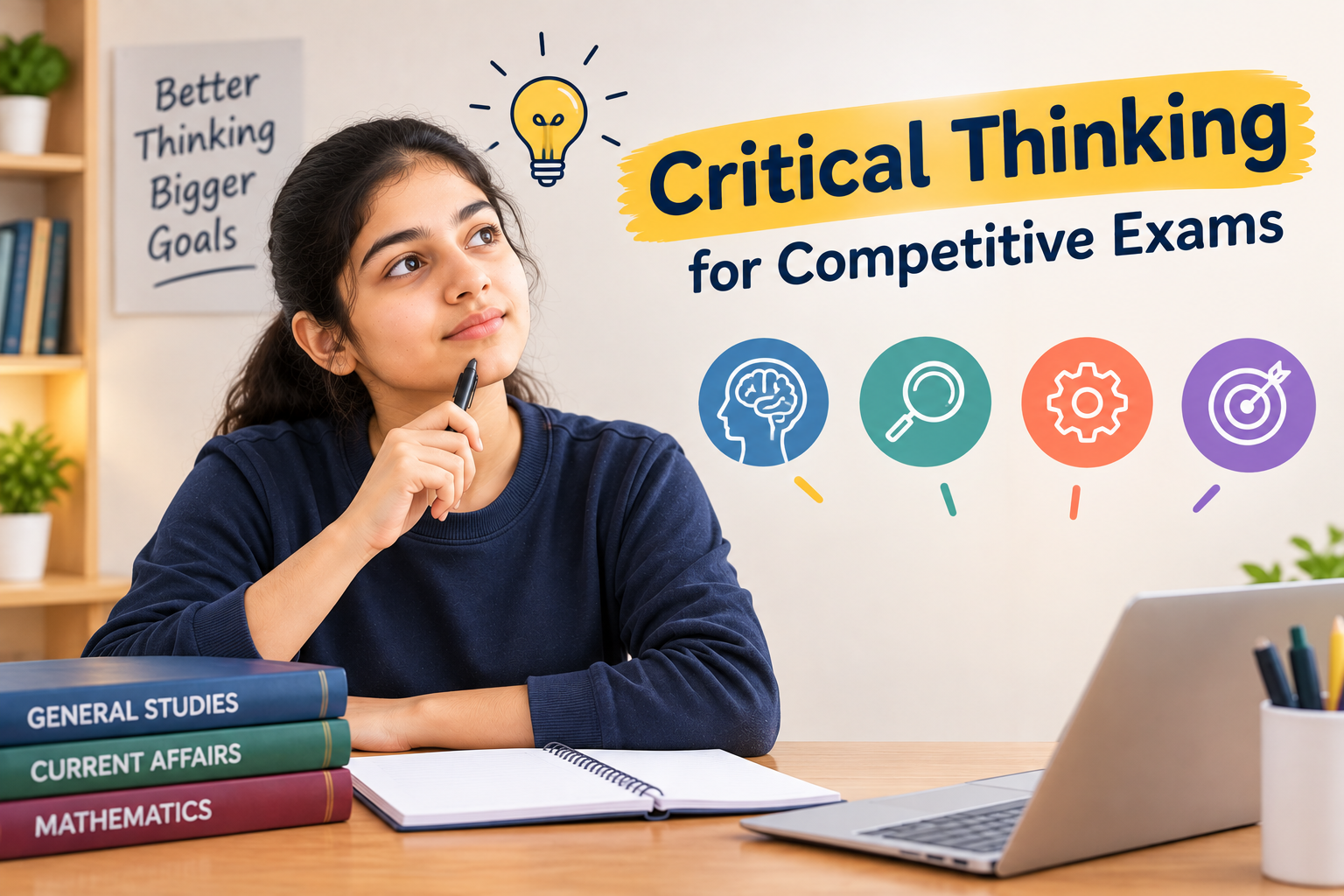
Competitive exams are often associated with memorising facts, learning large amounts of information and practising questions repeatedly. These habits have value, but strong performance also depends on something deeper: the ability to think clearly. Critical thinking helps students understand information, question assumptions, compare different ideas, evaluate evidence and reach logical conclusions.
For students who are interested in long-term preparation for examinations such as UPSC or KPSC, developing this ability early can be more useful than trying to memorise an advanced syllabus. The goal at school level is not to turn a student into a full-time competitive-exam aspirant. It is to develop habits of thinking that will support learning later.
What Is Critical Thinking?
Critical thinking means examining information carefully before accepting a conclusion. Instead of simply asking, “What is the answer?”, a student learns to ask, “Why is this the answer?” and “What evidence supports it?”
A critical thinker can separate facts from opinions, identify assumptions, compare viewpoints and recognise when information may be incomplete. This does not mean questioning everything unnecessarily. It means learning to make decisions based on reasoning rather than simply accepting the first explanation.
Why Is Critical Thinking Important for Competitive Exams?
Competitive examinations require students to work with information and apply what they know. Questions may test understanding, interpretation, reasoning and the ability to distinguish between closely related choices.
Critical thinking can help in several ways. First, it improves comprehension because students learn to look for meaning rather than memorise isolated sentences. Second, it helps them compare alternatives and identify the strongest explanation. Third, it encourages students to examine evidence and avoid conclusions based only on assumptions. Finally, it supports better decision-making when a question has several plausible options.
These habits are particularly valuable for examinations that require both factual knowledge and analytical understanding.
How Can Students Develop Critical Thinking?
The first step is to ask better questions. When reading a news story, textbook passage or general-interest article, students can ask: What happened? Why did it happen? Who is affected? What could happen next? Are there different viewpoints? What evidence is available?
The second step is to compare ideas. If a topic has two different explanations, students can write down the main point of each one and identify where they agree and disagree. This simple exercise teaches them to look beyond a single viewpoint.
The third step is to check evidence. Students should learn that an assertion and a fact are not always the same thing. When they encounter a claim, they can ask what information supports it and whether the source is reliable. This is especially useful when reading information online.
The fourth step is to explain answers in their own words. Instead of memorising a definition, a student can try to explain the concept to a friend or write a short paragraph about it. If they can explain an idea clearly, they are more likely to have understood it.
Critical Thinking Through Current Affairs
Current affairs provide a natural way to practise critical thinking. Students do not need to memorise every headline. They can choose one age-appropriate issue and explore it through simple questions.
For example, after reading about a new government initiative, a student could ask what problem the initiative is intended to address, who may benefit from it and what challenges could arise during implementation. The exercise is not about producing an expert policy analysis. It is about learning to connect information with causes, effects and different perspectives.
This approach also makes news reading more meaningful and can improve communication because students have ideas they can discuss and explain.
Critical Thinking Through Debate and Discussion
Debate and structured discussion are another useful way to develop critical thinking. Students learn to listen to an opposing view, identify the reasoning behind it and respond respectfully.
A good discussion should not become a competition to speak the loudest. Students should be encouraged to support their points with examples, distinguish evidence from personal opinion and change their position when stronger reasoning is presented.
These habits build communication, confidence, listening and leadership skills alongside analytical thinking.
Simple Critical Thinking Activities for Students
Critical thinking can be practised through small daily activities. Students can summarise a news story in three sentences, identify the main claim in an article, list two different viewpoints on an issue, solve reasoning puzzles, explain why an answer is correct, or create questions based on what they have read.
Teachers and parents can also ask open-ended questions instead of immediately providing answers. Questions such as “What do you think?”, “Why?”, “What evidence supports that?” and “Is there another way to look at this?” encourage students to think independently.
The Role of Critical Thinking in UPSC Foundation Preparation
For students considering civil services in the future, critical thinking is a foundation skill rather than a separate examination subject. UPSC preparation eventually involves understanding subjects, interpreting issues, writing structured answers and analysing information. Developing the underlying thinking habits early can make later learning more purposeful.
At school level, however, preparation should remain age-appropriate. Students should continue to give priority to their regular school education while gradually developing reading, reasoning, current-affairs awareness, writing and communication skills.
At Compass IAS Academy, the IAS @ School programme follows this foundation-oriented approach. For students in Classes 8–12, learning includes current affairs, reasoning, analytical thinking, reading, writing, public speaking, debate, discussions and mentoring. The purpose is to help students develop useful skills without replacing their normal school education or creating unnecessary academic pressure.
Critical thinking is not a skill that develops overnight. It grows through repeated practice: reading carefully, asking questions, listening to different viewpoints, checking evidence and explaining ideas clearly. Students who build these habits early are not simply preparing for one future examination. They are learning how to understand information and make better decisions.
That is why critical thinking deserves a place in any strong foundation for competitive examinations. The earlier students learn to think beyond memorisation, the stronger their approach to learning can become.