How to Read Newspapers Effectively
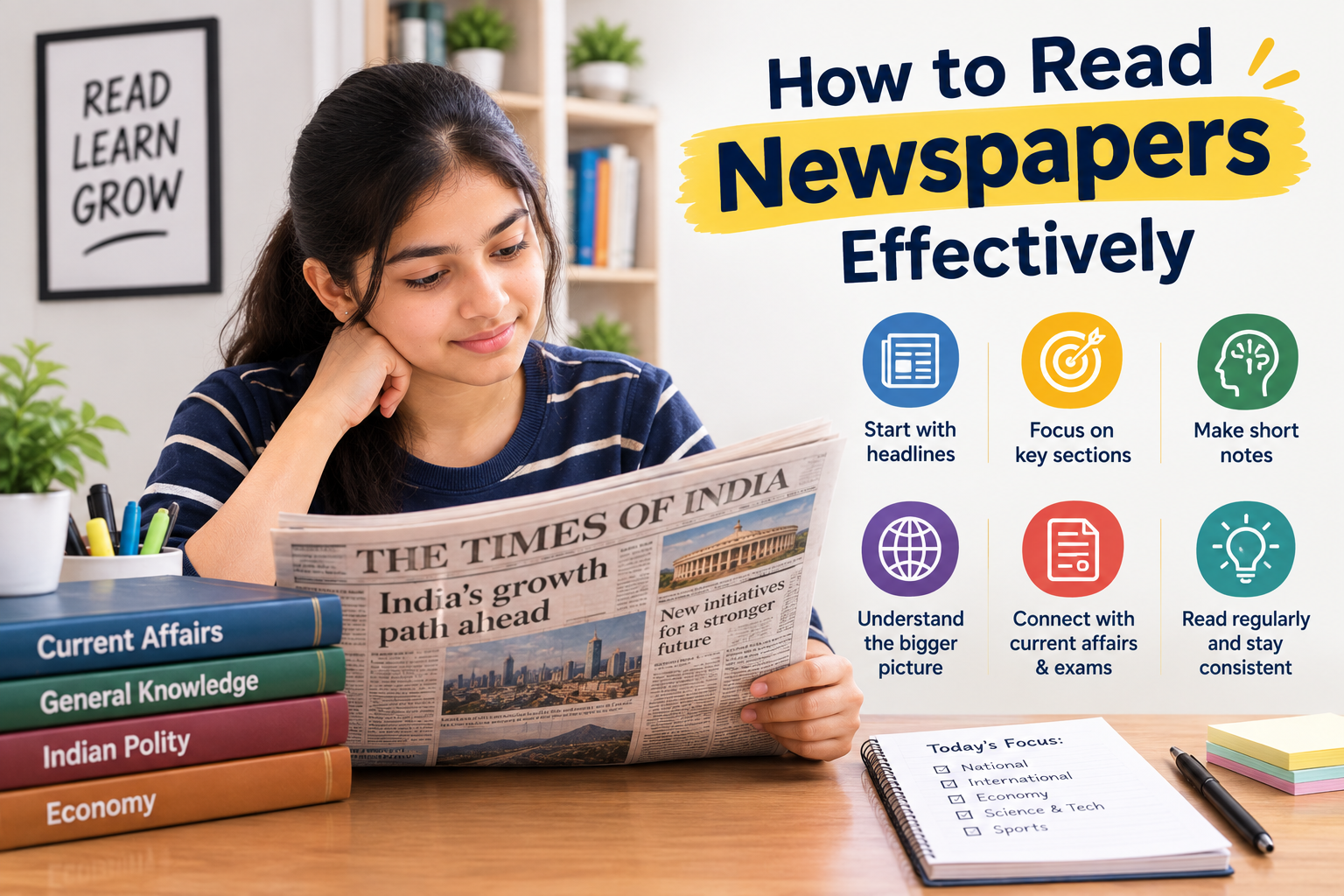
Reading newspapers is a useful habit for students who want to understand the world beyond their textbooks. News introduces students to government, society, science, technology, the environment, the economy, international events and issues affecting everyday life. However, reading a newspaper effectively does not mean reading every page from beginning to end. The real skill is knowing what to read, what to understand and what can be skipped.
For school students, newspaper reading should begin with curiosity rather than examination pressure. The purpose is not to turn a Class 8, 9, 10, 11 or 12 student into a full-time UPSC aspirant. Instead, regular exposure to meaningful news can gradually develop awareness, reading ability, vocabulary, reasoning and the habit of asking questions.
The first step is to choose a reliable newspaper or news source that matches the student's age and reading ability. Students do not need to follow multiple newspapers every day. One reliable source, read consistently, is generally more useful than trying to consume large amounts of information from several sources.
When opening a newspaper, students should first look at the major headlines. This gives them an overview of what is happening. They can then select a few stories that are meaningful or connected to areas they want to understand better. For example, a student might choose a story about a government initiative, an environmental issue, a scientific development or an important event in Kerala.
The next step is to read the selected article carefully. Students should try to identify the basic facts: What happened? Where did it happen? Who is involved? Why is it important? What could happen next? These questions turn newspaper reading into an exercise in understanding rather than simply collecting information.
Students should also learn to distinguish between news and opinion. A news report generally describes an event or development, while an opinion or editorial presents an argument or interpretation. Both can be useful, but students should understand the difference. Learning to recognise different viewpoints is an important part of developing independent thinking.
Another useful habit is connecting news with what students already learn in school. A story about an election can connect with civics. A report about rainfall or climate can connect with geography and environmental studies. A scientific discovery can connect with science lessons. This makes school subjects more relevant because students can see how concepts from textbooks appear in real life.
Vocabulary is another benefit of regular newspaper reading. Students will encounter unfamiliar words, expressions and ideas. Instead of stopping at every difficult word, they can first try to understand its meaning from the context. A small notebook or digital list can be used to record useful words and their meanings. Over time, this can improve both reading and writing.
Students should avoid trying to memorise every number, name and date they encounter. This is one of the most common mistakes in examination-oriented newspaper reading. For school students especially, understanding the larger issue is more valuable than memorising isolated facts. If a particular topic is important, they can return to it later and explore it in greater depth.
Short summaries can make newspaper reading even more effective. After reading an article, students can write three or four sentences explaining what happened and why it matters. They can also discuss the topic with a parent, teacher or mentor. Explaining something in their own words is a powerful way to check whether they have actually understood it.
Discussions can take the process one step further. Students can ask whether there are different perspectives on an issue, who might benefit from a particular decision and what challenges could arise. They do not need to have a perfect answer. The objective is to become comfortable with thinking, questioning and expressing ideas.
For students interested in future UPSC or KPSC preparation, these habits can become a useful foundation. Civil-services preparation eventually requires students to connect concepts with current events, understand different perspectives and communicate ideas clearly. Developing these habits gradually during school can make such learning more familiar later.
At Compass IAS Academy, current affairs and general awareness are part of the IAS @ School foundation programme for students from Class 8 to 12. Students are encouraged to engage with news through discussion, questions, reasoning, quizzes and activities rather than treating current affairs as a list of facts to memorise. The wider programme also develops reading, writing, analytical thinking, public speaking, debate and communication.
Most importantly, newspaper reading should remain manageable alongside school education. Students do not need to spend hours every day reading complicated articles. A consistent routine focused on a few meaningful stories can be much more effective. During examinations, school priorities should naturally come first.
The goal of newspaper reading at school age is simple: understand the world, ask better questions and become a more informed learner. When students learn how to read news thoughtfully rather than mechanically, a newspaper becomes more than a collection of headlines. It becomes a practical tool for developing awareness, curiosity, reasoning and communication skills that can remain valuable throughout their education and beyond