IAS Coaching in Kozhikode for Graduates: A Guide for UPSC Aspirants
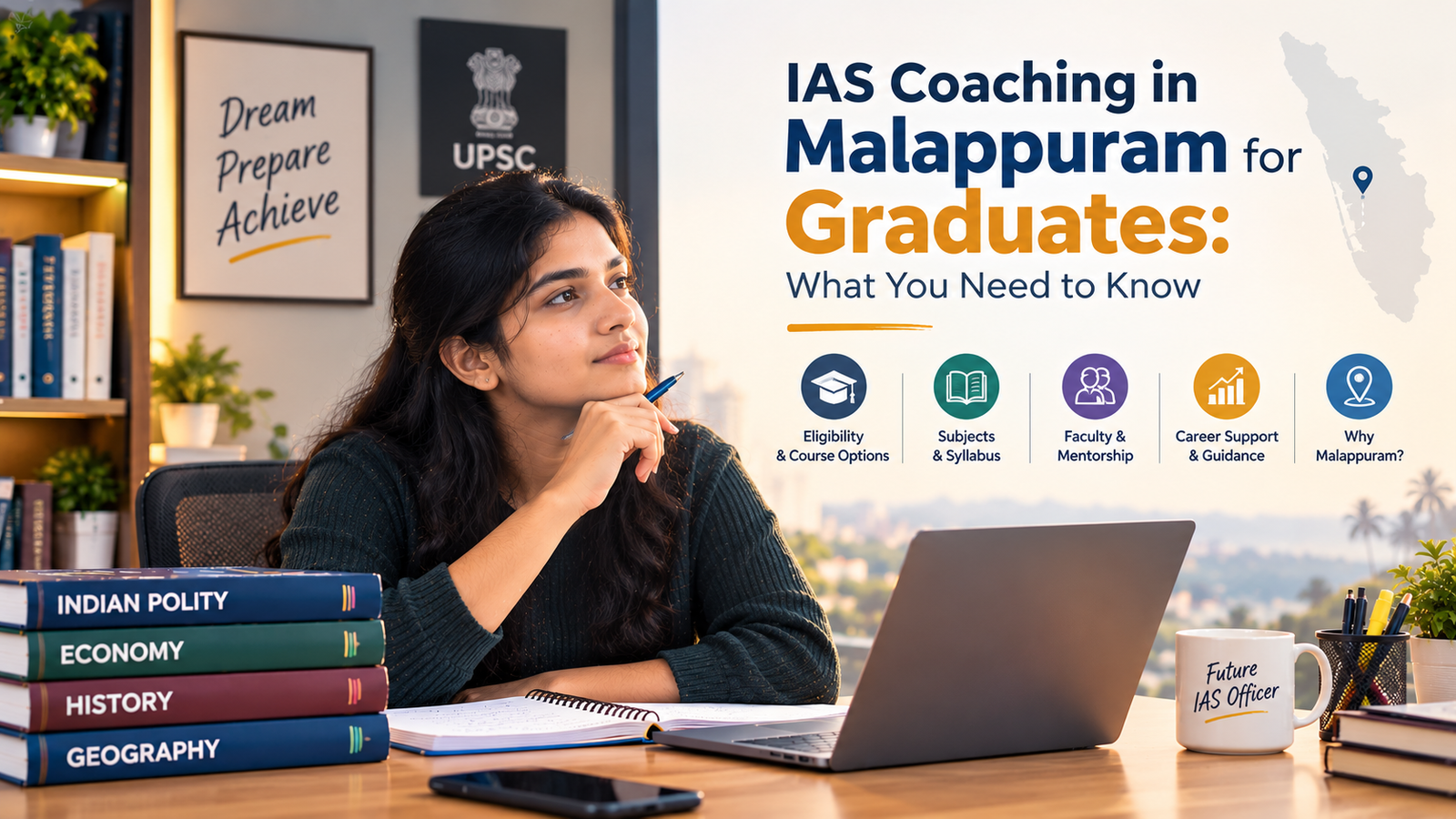
For graduates, starting preparation for the UPSC Civil Services Examination is a serious academic decision that requires a clear plan from the beginning. Graduation provides a useful academic foundation, but the UPSC examination demands a much broader combination of knowledge, analytical ability, writing skills, current-affairs awareness and consistent practice. An aspirant cannot usually prepare effectively by simply attending classes or collecting study materials. The preparation journey involves understanding the syllabus, building concepts, revising repeatedly, solving questions, writing answers, following important developments and regularly checking progress. This is why graduates searching for IAS coaching in Kozhikode should evaluate the complete preparation system offered by an institute rather than choosing only on the basis of location, advertisements or course fees.
For students from Kozhikode and the surrounding areas, there are several practical factors to consider before selecting a coaching institute. A graduate may be able to travel to a classroom centre every day, while another aspirant may need a different schedule because of work, family responsibilities or other commitments. Some students benefit from the discipline of a fully offline learning environment, while others may need online flexibility. The important question is not whether one format is universally better, but whether the chosen arrangement can be maintained consistently for the long preparation period. UPSC preparation requires regular self-study in addition to classes, so students should consider travel time, daily schedules and the amount of independent study that a course allows.
The first major factor to examine is the structure of the UPSC Civil Services Examination itself. The examination progresses through the Preliminary Examination, Main Examination and Personality Test, and each stage demands a different set of abilities. Prelims requires strong conceptual understanding, factual awareness, elimination skills, accuracy and the ability to solve questions under time pressure. Mains requires deeper understanding, analysis, organised thinking and the ability to present relevant arguments within a limited word and time framework. The Personality Test requires broad awareness, communication and the ability to express views clearly. A graduate-level coaching program should therefore help students understand this complete journey instead of treating UPSC as a single examination that can be prepared for through memorisation alone.
Course structure is especially important for graduates because the syllabus can become overwhelming without a clear progression. Before joining an institute, aspirants should understand how the course is organised from the first stage to revision and testing. A useful program should provide a realistic roadmap for completing subjects, revising important areas and gradually increasing examination practice. Students should know whether the institute follows a planned sequence, how current affairs are integrated with static subjects, when revision takes place and how tests are distributed across the course. A clear structure helps an aspirant avoid constantly changing resources or creating a new study plan every few weeks.
For serious graduates, an integrated Prelims-cum-Mains approach can be particularly useful because the two stages of the examination are closely connected. Preparing exclusively for Prelims for a long period and postponing Mains-oriented work can create pressure later, especially when an aspirant has not developed answer-writing habits. An integrated program allows students to build conceptual understanding, practise objective questions and gradually develop descriptive writing skills at the same time. The same topic can often be approached differently in Prelims and Mains, so learning to understand a subject from both perspectives can make preparation more connected and purposeful.
Faculty quality is another important factor when comparing IAS coaching options in Kozhikode. Graduates should try to understand who is actually teaching the subjects and whether the faculty can explain concepts in a way that supports examination-oriented learning. Strong teaching is not simply about completing chapters or dictating notes. Students need explanations that help them understand relationships between concepts, connect static subjects with current developments and identify what is relevant to the UPSC syllabus. It is also useful to consider the faculty's own exposure to the UPSC examination process and whether students have opportunities to ask questions and receive academic guidance beyond regular classroom sessions.
Regular testing should be considered a core part of the coaching system rather than an optional extra. UPSC preparation involves a large amount of information, and students need a reliable way to determine whether they can actually apply what they have studied. Tests can reveal gaps in conceptual understanding, factual recall, question interpretation, time management and revision. A strong test system should progress from topic-level assessments to broader tests and provide opportunities for repeated practice. For Mains preparation, answer-writing practice is equally important because an aspirant must learn to understand the demand of a question, organise ideas, remain relevant and complete the answer within the available time.
Feedback makes testing much more valuable. A score alone may tell a student that an answer was weak, but it does not necessarily explain what needs to change. Useful feedback can help an aspirant identify whether the problem lies in content, structure, relevance, analysis, presentation or time management. Graduates comparing coaching institutes should therefore ask how tests are evaluated and whether students receive meaningful guidance on improving performance. Regular review can turn mistakes into part of the learning process rather than allowing the same weaknesses to continue throughout preparation.
Current affairs should also be integrated carefully into graduate-level UPSC preparation. The objective is not to memorise every headline or accumulate large amounts of daily information. Aspirants need to understand important issues, their background, causes, consequences and relevance to the syllabus. A good current-affairs system can help students connect developments with areas such as polity, economy, environment, governance, international relations and society. This approach develops the habit of analysing issues, which is more useful for UPSC than simply remembering isolated facts. Graduates should therefore look at how an institute selects, explains and revises current affairs rather than asking only whether daily current-affairs material is provided.
Mentorship can become particularly important during the graduate preparation stage because many aspirants struggle not with motivation at the beginning, but with maintaining direction over several months. Students may accumulate multiple books, online resources, test series and current-affairs sources and then find it difficult to decide what should receive priority. A structured mentor can help an aspirant create realistic study targets, review performance, identify weak areas and make changes when the preparation strategy is not working. When comparing IAS coaching in Kozhikode, graduates should ask whether mentorship is a genuine part of the program and whether individual progress is reviewed periodically.
Study materials should also be evaluated with care. UPSC aspirants can easily collect more resources than they can realistically revise. A useful coaching institute should help students identify core sources and develop a manageable revision system rather than encouraging endless accumulation of books and PDFs. The objective should be to understand important material deeply and revise it multiple times. Graduates should also consider whether the institute provides guidance on how to use its materials alongside standard sources, current affairs and test preparation.
Self-study time is one of the most important aspects of any graduate-level program. Coaching can provide structure, but a significant part of UPSC preparation takes place outside the classroom. Students need time to read, revise, solve questions, follow current affairs, practise answer writing and review mistakes. A course timetable that fills almost the entire day with classes may leave insufficient time for independent learning. When selecting an institute, graduates should therefore look at the balance between classroom instruction and self-study. The strongest preparation system is one that uses classes to provide direction and explanation while giving students enough time to work independently.
The learning environment and accessibility should also be considered together. Offline coaching can provide direct interaction with faculty and fellow aspirants and may help some students maintain a fixed routine. At the same time, daily travel can become tiring if the journey is long, reducing the time available for self-study. Students from different parts of Kozhikode may therefore need to compare convenience with the quality of the program. Location is important, but it should be considered alongside faculty, course structure, testing, mentoring and the overall academic environment.
For graduates in Kozhikode and nearby areas, Compass IAS Academy in Areekode, Kozhikode district, is one option to consider when comparing coaching opportunities in North Kerala. Compass offers a one-year, fully offline, on-campus Prelims-cum-Mains program designed for graduates preparing intensively for the UPSC examination. The program follows an integrated approach to Prelims and Mains preparation and includes structured academic support and regular testing. Compass's broader approach emphasizes analytical thinking, character development, competence and mentorship rather than relying only on rote memorisation.
The faculty profile is another factor graduates can consider when evaluating Compass alongside other institutes. Compass faculty have cleared UPSC Prelims at least twice and have appeared in the UPSC Interview process. For an aspirant comparing coaching options, this can be considered together with the actual course schedule, testing system, current-affairs support, mentoring arrangements, learning environment and accessibility. The goal should be to understand what the complete program provides and whether it fits the student's preparation needs.
Graduates should also think carefully about their own preparation stage before selecting a course. Someone who is just beginning may need more guidance in understanding the syllabus, selecting resources and creating a sustainable routine. An aspirant who has already completed a significant part of the syllabus may need stronger testing, revision and answer-writing support. Choosing a program simply because it is marketed as an IAS course may not be enough. The program should address the specific gap in the student's current preparation.
Before enrolling, it is useful to create a simple comparison checklist and speak directly with the institute about what is included. Check faculty, syllabus coverage, Prelims and Mains integration, class schedule, current-affairs support, test frequency, answer-writing practice, study materials, mentoring and progress tracking. Also ask how much self-study time the timetable leaves and how the institute supports students who are struggling with a particular subject or preparation area. These questions can reveal more about the quality of a coaching system than promotional claims alone.
Finally, graduates should maintain realistic expectations about coaching. No institute can guarantee success in the UPSC examination, and classroom instruction cannot replace an aspirant's own discipline, revision and practice. The purpose of good coaching is to make preparation more structured, reduce unnecessary confusion and provide reliable opportunities to learn, practise and improve. For a graduate looking for IAS coaching in Kozhikode, the best choice is therefore not simply a place with more classes, but a preparation environment that combines strong teaching with testing, current-affairs understanding, answer writing, mentorship and sufficient self-study time. A careful comparison at the beginning can help an aspirant begin the UPSC journey with greater clarity and maintain a more sustainable preparation routine over the long term.