IAS Foundation Program vs Traditional Coaching: Which Approach Is Better for Students?
When students and parents hear the words IAS coaching, they often imagine long study hours, large textbooks, frequent tests and intensive examination preparation. That model can be useful for graduates who are preparing seriously for the UPSC examination. But school students have different needs.
For a student in Class 8, 9, 10, 11 or 12, the goal should not necessarily be to complete an adult UPSC syllabus. A foundation programme can instead focus on building the habits and abilities that will become valuable when serious preparation begins later. Understanding the difference between a foundation approach and traditional coaching can help parents choose a more suitable path.
What Is Traditional UPSC Coaching?
Traditional UPSC coaching is generally designed for candidates who are closer to the examination stage. The focus is usually on completing the prescribed syllabus, understanding examination requirements, revising large amounts of material, practising questions and writing answers, and taking regular tests.
This approach can be appropriate when a student is ready for structured, examination-focused preparation. However, applying the same model to a school student can create unnecessary pressure if the student's primary academic responsibility is still school education.
What Is an IAS Foundation Program?
An IAS foundation programme introduces students to skills and areas of knowledge that can support future civil-services preparation. Instead of rushing through the full UPSC syllabus, it develops reading, current-affairs awareness, reasoning, analytical thinking, communication, writing and discussion skills.
The emphasis is on gradual development. Students learn how to understand information, ask questions, express ideas and connect classroom learning with real-world issues. This creates a stronger base for future UPSC or KPSC preparation.
1. Foundation Learning Is More Age-Appropriate
School students are still developing academically and personally. Their learning should match their age, school curriculum and existing responsibilities. A foundation programme can introduce civil-services-related concepts without expecting a school student to study like a full-time graduate aspirant.
This makes the learning experience more sustainable. Students can explore subjects and ideas while continuing to give proper attention to school examinations, hobbies, rest and other activities.
2. The Focus Is on Skills, Not Only Syllabus Completion
One of the biggest differences is the objective. Traditional coaching often asks, “How much of the examination syllabus can we cover?” A foundation programme asks, “What skills should the student develop now?”
Reading comprehension, reasoning, critical thinking, writing, speaking and listening are not developed overnight. Giving students time to practise these skills can be more valuable than simply making them memorise advanced material years before they need it.
3. Current Affairs Can Be Learned Through Understanding
A foundation approach can introduce current affairs in a way that encourages curiosity. Instead of asking students to memorise every headline, teachers can help them understand what happened, why it matters and how it connects with society, government, science, the economy or the environment.
Over time, this can help students become comfortable with the habit of following important developments and thinking about their significance.
4. Communication and Public Speaking Become Part of Learning
Traditional examination preparation can naturally give more attention to reading and written practice. A foundation programme can also make communication a regular part of learning through discussions, presentations, debates and speaking activities.
This helps students practise explaining an idea clearly rather than simply reproducing a memorised answer. Such communication skills can remain useful throughout education and professional life, regardless of whether a student eventually chooses civil services.
5. Mentoring Can Guide Students Gradually
Young students often need guidance about study habits, reading, time management, confidence and academic priorities. Mentoring can help them understand where they are improving and where they need more practice.
A good foundation programme should therefore give students space to ask questions, discuss difficulties, receive feedback and develop realistic learning routines instead of simply assigning more material.
6. A Foundation Programme Should Not Replace School Education
This is an important distinction. Early civil-services preparation should support school education rather than interfere with it. Students still need time for their school subjects, board examinations, rest and personal development.
A practical foundation schedule therefore uses manageable sessions instead of demanding the long daily study hours associated with full-time competitive-exam preparation.
7. Traditional Coaching Becomes More Useful at the Right Stage
This comparison is not about saying that traditional UPSC coaching is ineffective. It is about timing. Once a student reaches the stage where serious UPSC preparation is appropriate, an examination-focused programme can provide structured syllabus coverage, test practice, revision and answer-writing support.
The foundation stage and the serious preparation stage can therefore complement each other. The purpose of foundation learning is to make the later transition more comfortable and organised.
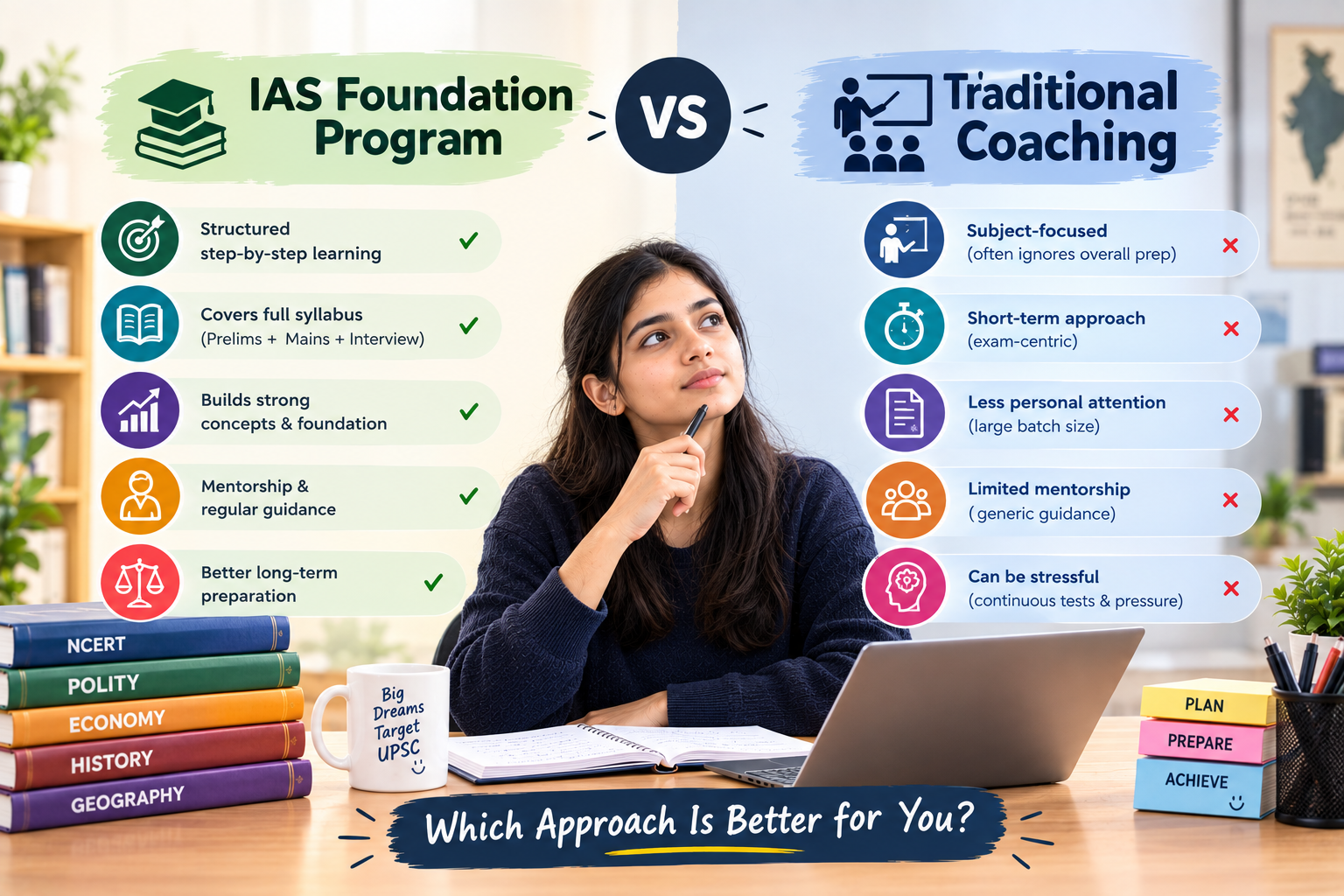
IAS Foundation Program vs Traditional Coaching: A Simple Comparison
A foundation programme focuses on long-term skill development, age-appropriate learning, current-affairs awareness, reasoning, communication, reading and mentoring. Traditional coaching focuses more directly on examination preparation, syllabus coverage, revision, tests and performance.
For a graduate preparing for the UPSC examination, traditional coaching may be the more relevant model. For a school student who wants to explore civil services and develop a strong base, a foundation approach is generally more appropriate.
How Compass IAS Academy Approaches Foundation Learning
Compass IAS Academy's IAS @ School programme for Classes 8 to 12 is designed around this foundation approach. It includes current affairs, UPSC and KPSC-related subjects, general knowledge, reasoning and analytical thinking, public speaking, debate, communication, reading, writing, discussions, quizzes, mock tests, activities and mentoring.
The programme uses a school-friendly schedule, with online learning designed to avoid unnecessary interference with school and board preparation. The emphasis is on developing thinking skills, awareness and communication rather than turning school students into full-time UPSC aspirants.
Which Approach Should Parents Choose?
The right choice depends on the student's age, academic stage and level of readiness. Parents should ask whether the programme is helping the student develop useful skills or simply increasing the amount of material to study.
For school students, look for age-appropriate teaching, manageable schedules, meaningful mentoring, reading and current-affairs exposure, opportunities to speak and write, and activities that encourage independent thinking. For graduates who are ready for serious examination preparation, a more intensive and examination-focused coaching model may be appropriate.
The key is not to start with maximum pressure. It is to start with the right kind of preparation at the right stage. A strong foundation can help students enter serious UPSC preparation later with better reading habits, stronger reasoning, clearer communication and greater confidence.