Reading Habits of Successful UPSC Aspirants: How Students Can Build a Strong Reading Habit Early
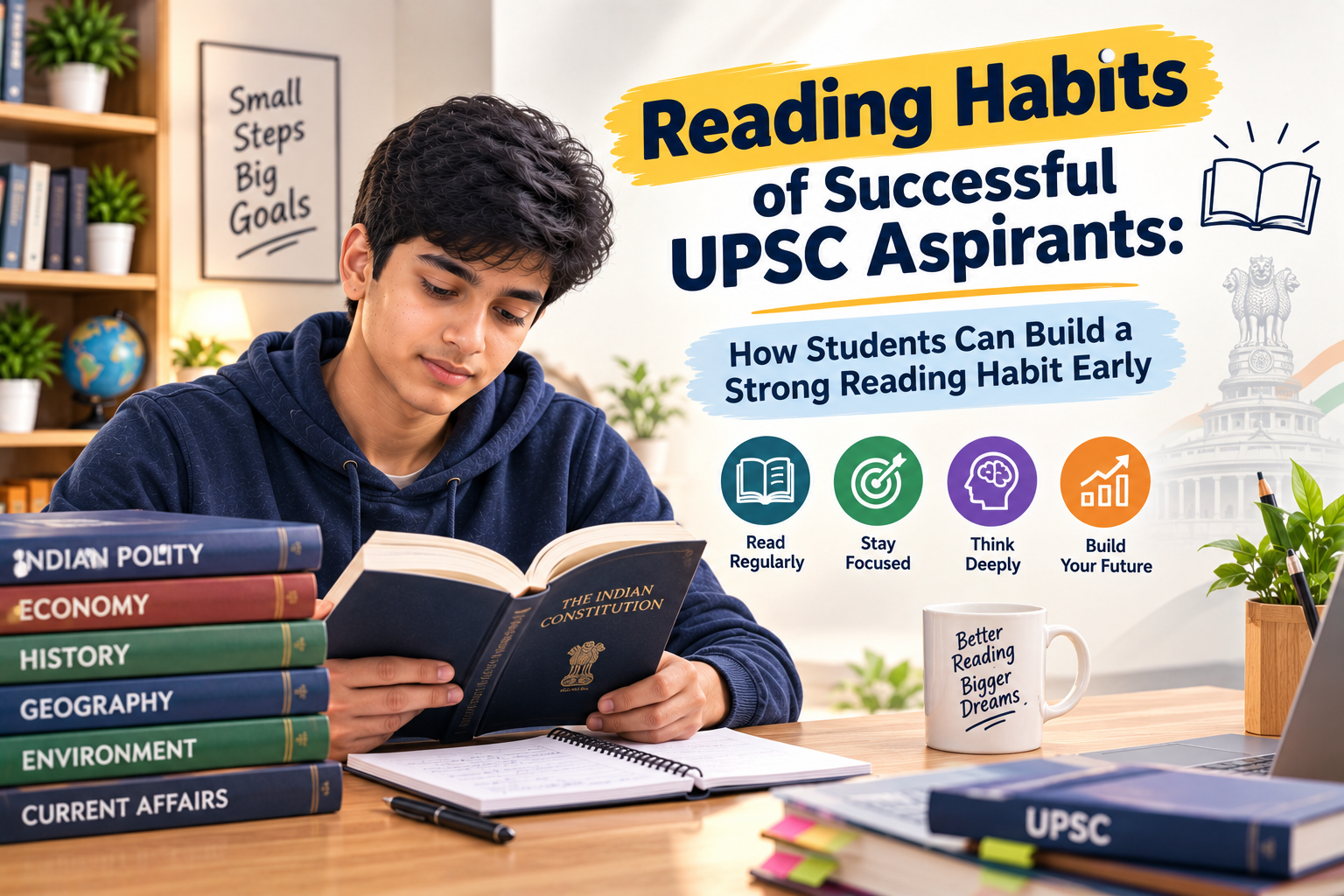
Reading is one of the most important habits a student can develop for long-term academic and competitive-exam preparation. For future UPSC aspirants, reading becomes especially valuable because the examination requires a broad understanding of subjects, current affairs and issues affecting society.
However, students do not need to begin by reading advanced UPSC books for several hours every day. A strong reading habit develops gradually. The real objective at school level is to learn how to read regularly, understand what is being read, identify important ideas and explain them clearly.
Why Reading Matters for UPSC Preparation
UPSC preparation involves studying a wide range of subjects and understanding connections between them. Students eventually need to work with textbooks, reference material, newspapers, reports and other sources.
A student who develops good reading habits early can become more comfortable with longer and more complex material over time. Reading also supports vocabulary, comprehension, writing and general awareness.
Most importantly, effective reading is not simply about finishing pages. It is about understanding ideas.
Start With Consistency, Not Volume
One of the biggest mistakes students make is trying to read too much at once. A better approach is to read regularly for a manageable amount of time.
A student might begin with a short article, a few pages of a book or a selected newspaper story. The amount can gradually increase as the habit becomes stronger.
Consistency matters more than the number of pages completed on a particular day. A student who reads thoughtfully every week is building a more useful habit than someone who reads a large amount for a few days and then stops.
Choose Age-Appropriate Reading Material
School students should choose material according to their age, interests and academic level. Reading does not have to begin with standard UPSC reference books.
History, geography, science, biographies, social issues, environment, current affairs and well-written general-interest articles can all help develop knowledge and curiosity.
School textbooks are also important. Students should learn to read them carefully rather than treating them only as material for examinations. Understanding concepts in school subjects can create a strong base for future learning.
Read Newspapers With a Purpose
Newspapers can help students understand what is happening in Kerala, India and the world. But reading every page is unnecessary.
Students can begin by selecting meaningful stories related to government, society, science, environment, economy, education, international events and other important issues. The goal is to understand the event rather than memorise every detail.
While reading a news story, students can ask simple questions: What happened? Why did it happen? Who is affected? Why is it important? What could happen next?
These questions turn newspaper reading into an exercise in understanding and analytical thinking.
Learn to Separate Facts From Opinions
A strong reader should understand that not every statement in a newspaper, article or online post has the same status.
Students can learn to distinguish between a reported fact, an interpretation and an opinion. They can also ask whether a claim is supported by evidence.
This habit is useful not only for competitive examinations but also for becoming a thoughtful reader in everyday life.
Write Short Summaries
Writing is one of the best ways to check whether reading has actually led to understanding.
After reading an article or chapter, students can close the material and write three to five sentences explaining the main idea. They can identify the central issue, the important facts and the conclusion.
The summary does not need to use complicated language. Clear writing in the student's own words is more valuable than copying sentences from the source.
Build Vocabulary Naturally
Regular reading naturally exposes students to new words. Instead of trying to memorise long vocabulary lists, students can note useful words they encounter in context.
For each unfamiliar word, they can learn its meaning, see how it is used and try to use it in a sentence. Over time, this can improve both comprehension and communication.
Students should also avoid becoming dependent on a dictionary for every unfamiliar word. Sometimes the surrounding sentences provide enough context to understand the general meaning.
Discuss What You Read
Reading becomes more powerful when students discuss ideas. A student can talk about a news story with a parent, teacher or friend and explain why it matters.
Discussion encourages students to organise their thoughts and listen to different perspectives. It can also reveal gaps in understanding and encourage further reading.
This is particularly useful for current affairs and social issues, where more than one viewpoint may exist.
Learn Simple Note-Making
Note-making should not become another form of copying. Students can experiment with short points, keywords, simple diagrams or question-and-answer notes.
For example, after reading about a government institution, a student might write what the institution does, why it exists and how it affects citizens.
The purpose of notes is to make later revision easier and to help organise information.
Develop the Habit of Asking Questions
Strong readers are curious readers. Instead of accepting every statement immediately, students can ask why, how and what evidence supports an idea.
When reading about an event, they can think about its causes and effects. When reading about a historical development, they can ask what changed and why. When reading about science or the environment, they can ask how the concept works in real life.
This questioning habit connects reading with critical and analytical thinking.
Avoid Common Reading Mistakes
Students sometimes collect many books without finishing any of them. Others switch constantly between websites, videos and study materials.
A smaller number of reliable sources is usually easier to manage. Students should also avoid reading only for the purpose of highlighting everything. If almost every sentence is marked, highlighting stops being useful.
Another mistake is reading without reflection. After completing a chapter or article, students should pause and ask what they actually learned.
How Reading Supports Future UPSC and KPSC Preparation
Reading habits developed during school can support both UPSC and KPSC preparation later. Current affairs awareness, comprehension, general knowledge, vocabulary, writing and analytical thinking are useful across competitive examinations.
For students interested in civil services, this means that early reading does not have to be narrowly focused on one examination. It can be broad, curious and connected to school learning.
The Role of Compass IAS Academy
Compass IAS Academy's IAS @ School programme for Classes 8–12 includes reading, current affairs, reasoning, analytical thinking, writing, public speaking, debate, discussions, quizzes and mentoring.
The programme takes a foundation-oriented approach. Students are encouraged to develop useful learning habits while continuing to give appropriate attention to their regular school education. The goal is not to overload students with advanced examination material but to help them become stronger readers, thinkers and communicators.
Building a Reading Habit That Lasts
There is no single reading routine that works for every student. The best routine is one that can be followed consistently.
Start small. Choose reliable and age-appropriate material. Read carefully. Ask questions. Write short summaries. Discuss ideas. Gradually increase the quality and range of what you read.
For future UPSC aspirants, these habits can become an important foundation for serious preparation later. More importantly, they can make students better learners in school and beyond.
A strong reading habit is not about how many books a student can finish. It is about how well the student can understand, question, connect and communicate what they read