Title UPSC Roadmap for School Students: A Practical Path from Class 8 to 12
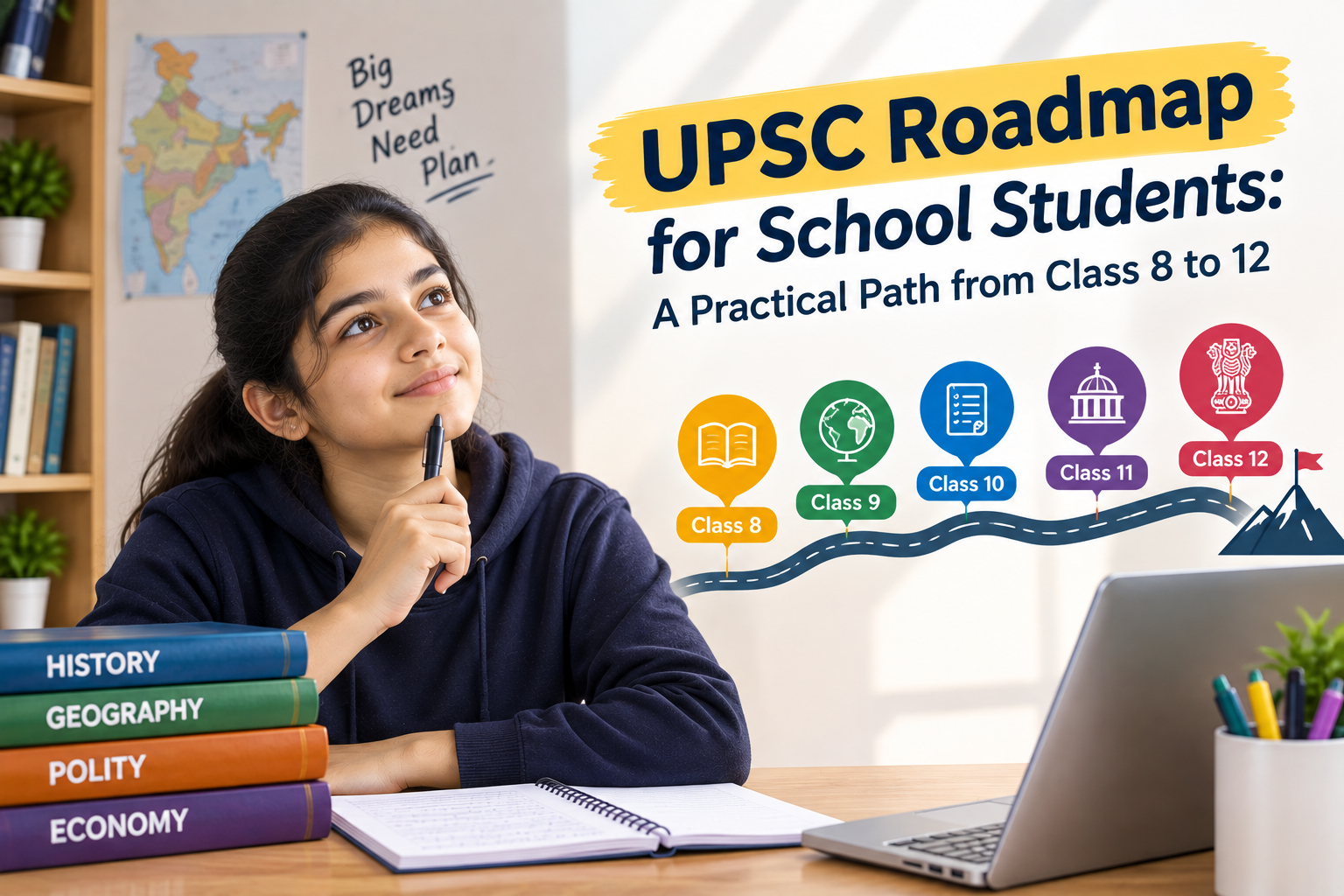
Preparing for the UPSC Civil Services Examination is a long-term journey. Students who become interested in civil services while they are still in school often wonder whether they should begin serious UPSC preparation immediately. The better approach is usually to build the right foundation first.
For school students, a UPSC roadmap should not mean completing the entire UPSC syllabus years before the examination. It should mean developing the knowledge, habits and thinking skills that make future preparation easier. Reading, current affairs, reasoning, analytical thinking, writing and communication can all be developed gradually while regular school education remains the priority.
Why Do School Students Need a UPSC Roadmap?
Without a clear plan, early preparation can easily become either too intense or too unstructured. Some students may try to study advanced books meant for graduates, while others may collect large amounts of current-affairs material without understanding it.
A roadmap gives students a sensible progression. Each school stage can have a different purpose. The objective is not to rush towards the examination but to develop useful skills step by step.
Classes 8 and 9: Build Curiosity and Strong Learning Habits
Classes 8 and 9 are suitable for developing curiosity about society, government, history, geography, science, the environment and events happening around the world.
Students can begin by reading age-appropriate news regularly and discussing important events. They can maintain a simple notebook for interesting topics rather than trying to memorise every headline.
Reading should be encouraged across different subjects. A student might read about a historical event, understand how a government institution works or explore a geographical issue. The focus should be on asking questions and understanding connections.
Reasoning activities, quizzes, short writing exercises and discussions can also help students become comfortable with thinking and expressing ideas.
Class 10: Strengthen Understanding and Analytical Skills
Class 10 is an important academic stage, so school and board preparation should remain the main priority. Alongside regular studies, students can strengthen their ability to understand information and explain it clearly.
Current affairs can become slightly more structured. Instead of simply reading what happened, students can ask why it happened, who was affected and what the possible consequences could be.
Students can also begin connecting news with subjects they learn in school. A news story about the Constitution, environment, economy or international relations can become an opportunity to explore the underlying concept.
Writing short summaries, participating in debates and solving reasoning questions can further strengthen analytical and communication skills.
Classes 11 and 12: Develop a More Structured Foundation
Classes 11 and 12 provide an opportunity to build a more organised foundation while continuing to focus on school and higher-secondary studies.
Students can start becoming familiar with broad areas that are relevant to civil services, such as Indian polity, history, geography, economics, environment, science and technology, and current affairs. The aim at this stage is understanding, not completing an advanced UPSC syllabus.
Reading habits can become more consistent. Students can learn to make short notes, identify important arguments and explain an issue in their own words.
Writing and communication also become increasingly valuable. Short answers, summaries, presentations, discussions and debates can help students organise their thoughts and communicate them with clarity.
A Simple Year-by-Year UPSC Foundation Plan
A practical roadmap can be organised around five areas.
First, reading. Begin with regular reading and gradually improve comprehension and vocabulary.
Second, current affairs. Start with awareness and understanding, then gradually learn to identify causes, effects and different viewpoints.
Third, reasoning and analytical thinking. Use puzzles, questions, comparisons and problem-solving exercises to develop logical thinking.
Fourth, writing and communication. Encourage students to summarise what they have learned, speak about topics and participate in discussions.
Fifth, mentorship and reflection. Students benefit from guidance that helps them understand what to study, how to improve and how to balance preparation with school responsibilities.
What Students Should Avoid
Early UPSC preparation can become counterproductive when students treat school as something separate from their future goals. Regular academic learning builds the foundation for many subjects that students will encounter later.
Students should also avoid collecting too many books, watching endless preparation videos or trying to memorise every current-affairs fact. More material does not automatically mean better preparation.
Another common mistake is comparing progress with older aspirants. A school student and a graduate preparing for the UPSC examination have different needs. Foundation preparation should be age-appropriate and sustainable.
How Compass IAS Approaches School-Level Foundation
Compass IAS Academy's IAS @ School programme is designed for students in Classes 8–12 and is fully online. The approach focuses on developing skills such as current-affairs awareness, reading, reasoning, analytical thinking, writing, public speaking, debate and discussion.
The programme also uses a school-friendly schedule, with learning planned around students' regular academic commitments. The purpose is to help students develop a strong foundation without replacing their school education or creating unnecessary pressure.
The Bigger Goal of Early Preparation
A good UPSC roadmap for school students is not simply about getting an early start on an examination. It is about becoming a better learner.
A student who learns to read carefully, understand current events, question assumptions, analyse information, write clearly and communicate confidently is building skills that remain valuable regardless of the career eventually chosen.
By Class 8 or 9, the goal can be curiosity and good habits. By Class 10, it can become stronger understanding and analytical thinking. In Classes 11 and 12, students can gradually move towards a more structured foundation.
There is no need to rush. Consistency matters more than intensity at this stage. A well-planned roadmap allows students to grow academically while steadily developing the skills that can support serious UPSC preparation later.