UPSC Coaching for Graduates in Malappuram: From Graduation to Civil Services Preparation
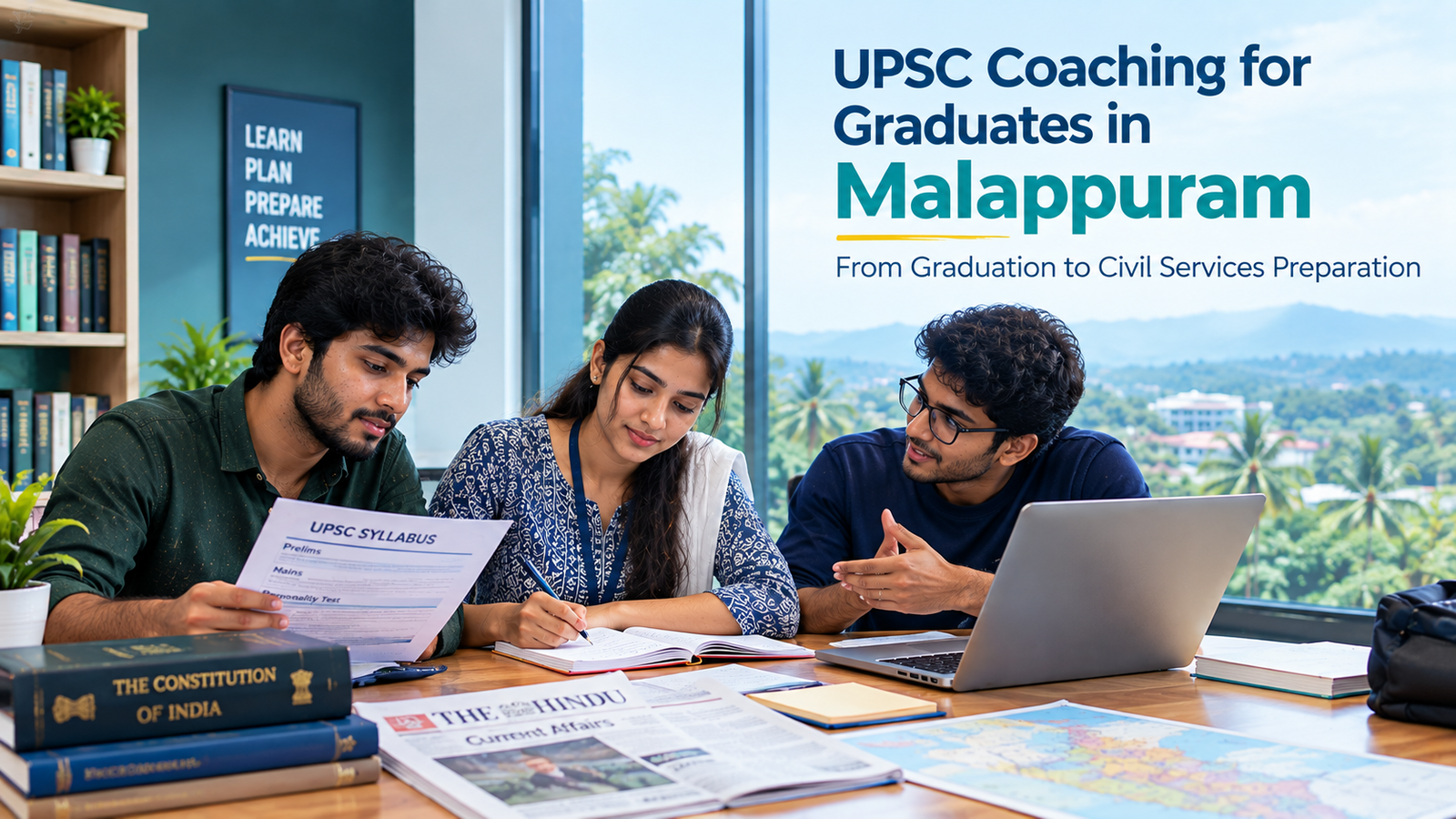
Graduation is an important turning point for anyone who wants to prepare seriously for the UPSC Civil Services Examination. During school and college, students can build broad awareness, reading habits, communication skills and analytical thinking, but after graduation the nature of preparation usually becomes much more focused. A graduate aspirant has to understand the examination in detail, study the prescribed syllabus, develop a realistic timetable, choose resources carefully and practise the skills required for both Prelims and Mains. The Union Public Service Commission conducts the Civil Services Examination through its official examination process, and the preparation therefore needs to be organised around the actual demands of the examination rather than around a vague idea of what an IAS aspirant should study. citeturn0search0turn0search6
For graduates in Malappuram and the wider North Kerala region, the first major decision is not simply whether to join coaching, but what kind of coaching is appropriate for their current stage. A graduate may be starting from the beginning, may already have some familiarity with the UPSC syllabus, or may have attempted the examination and discovered weaknesses in areas such as Prelims accuracy, Mains answer writing, current affairs integration or revision. These situations require different levels of support. A good coaching programme should therefore begin with an understanding of the aspirant's starting point and then provide a structured route towards the examination. The objective should not be to keep students dependent on classroom teaching; it should be to help them become capable of planning, studying, testing, reviewing and improving independently.
The UPSC preparation journey is easier to understand when it is divided into the stages of the examination. The Civil Services Examination requires preparation for the Preliminary Examination, followed by the Main Examination for candidates who qualify, and then the Personality Test stage for candidates who reach it. This means a graduate should avoid treating UPSC as a single subject or a single test. Prelims requires conceptual clarity, factual awareness, elimination ability and repeated objective practice, while Mains requires deeper understanding, structured thinking, answer writing and the ability to connect different dimensions of an issue. The final stage also requires the ability to communicate clearly and discuss one's background, interests and views with maturity. A coaching system that prepares only for one stage and postpones the others may create unnecessary pressure later; an integrated approach can help graduates understand the relationship between stages from the beginning.
One of the most important things to examine while choosing UPSC coaching for graduates in Malappuram is the structure of the course itself. A serious programme should provide a clear sequence instead of simply arranging lectures topic by topic. Graduates need to know what they are studying now, what will be revised later, when tests will be conducted, how mistakes will be analysed, when answer writing will begin and how current affairs will be connected with static subjects. An integrated Prelims-cum-Mains approach can be particularly useful because the aspirant is encouraged to build conceptual understanding once and learn how that understanding can be applied differently in objective questions and descriptive answers. This reduces the risk of preparing for Prelims in isolation and then starting Mains preparation from the beginning after the Prelims examination.
The syllabus should remain at the centre of the preparation process. Graduates often make the mistake of collecting books, videos, notes, magazines and online materials before understanding what the examination actually requires. This can create the feeling of studying continuously without being able to measure progress. A better approach is to map the syllabus, identify standard sources, understand the type of questions being asked and create a manageable cycle of learning, revision and testing. Every additional resource should have a clear purpose. If a new book explains the same topic that is already understood from a reliable source, it may add volume rather than value. Effective coaching should help students reduce this resource overload by giving them direction on what to study, what to revise and what to leave aside.
Current affairs also become much more useful when they are treated as part of the syllabus rather than as a separate daily burden. Graduates preparing for UPSC need to follow important developments in India and the world, but the purpose is not to memorise every headline. The stronger habit is to ask why an issue matters, what constitutional, economic, social, environmental, administrative or international dimensions it has, and how it may connect with a static subject. A well-designed current-affairs programme can therefore combine regular news discussion with revision and application. For a graduate, this approach helps transform news from a large collection of disconnected facts into material that can support understanding, Prelims preparation and Mains answer writing.
Regular testing is another major part of graduate-level UPSC preparation. Attending classes can create the impression of progress, but actual improvement becomes visible when an aspirant attempts questions under time constraints and studies the mistakes afterwards. Prelims tests can reveal problems such as weak concepts, over-attempting, poor elimination or insufficient revision. Mains tests can reveal different issues, including weak structure, inadequate examples, poor time management, lack of balance or difficulty in expressing ideas within the required word limit. The value of a test series therefore depends not only on the number of tests but also on the quality of evaluation and the student's willingness to act on feedback. A useful coaching environment should make testing part of the learning cycle rather than treating tests as an event that happens only near the examination.
Answer writing deserves particular attention after graduation because many aspirants understand a topic but struggle to convert that understanding into a clear Mains answer. Good writing practice is not simply about writing more pages. Graduates should learn how to identify what a question is asking, build an appropriate introduction, organise the main discussion, use relevant examples or arguments, maintain balance and conclude without repeating the question. Regular practice is important because speed and structure develop through repetition and review. Coaching can help by providing questions, model approaches, evaluation and feedback, but the aspirant still has to develop the habit of writing independently. This is one reason why a programme that integrates Mains preparation from the beginning can be more useful than a system that treats answer writing as a last-minute activity.
Optional-subject awareness is another area graduates should approach carefully. The optional subject can become a significant part of Mains preparation, so the choice should not be based only on what appears popular among other aspirants. A graduate should consider academic background, genuine interest, access to reliable material and guidance, the nature of the syllabus, and the ability to sustain preparation over time. Coaching need not make the decision for the student, but good mentoring can help an aspirant compare the practical factors before committing. The same principle applies to study materials, test series and online resources: decisions should be based on fit and usefulness rather than on the number of people recommending them.
Mentorship becomes especially valuable after graduation because UPSC preparation can become a long period of self-directed work. A graduate may know what to study but still struggle with questions such as whether the current pace is sufficient, whether too much time is being spent on one subject, when to revise, how to respond after a poor test, or how to balance Prelims and Mains. Regular mentoring can provide an external review of the preparation process and help the aspirant identify problems before they become habits. The strongest mentoring is practical rather than motivational alone: it looks at study plans, test performance, writing practice, revision patterns and individual difficulties, and then helps the student make specific adjustments.
Self-study time should also be protected when comparing coaching programmes. Coaching is useful for structure, explanation, discussion, testing and mentorship, but UPSC preparation cannot be completed through classroom attendance alone. Graduates need sufficient time to read, revise, practise questions, write answers, analyse tests and return to difficult topics. A timetable filled entirely with lectures can leave too little space for independent learning. The better question is therefore not how many classroom hours an institute offers, but whether the overall schedule creates a productive balance between guided learning and self-study. The right programme should give direction without taking away the time required to actually internalise what has been taught.
Location and learning environment matter as well, particularly for students considering offline coaching in and around Malappuram. A convenient location can reduce travel fatigue, but proximity alone should not determine the decision. Graduates should consider the quality of the academic environment, the availability of study support, the regularity of tests and mentoring, the discipline of the schedule, and whether the centre provides a serious atmosphere without creating unnecessary pressure. North Kerala aspirants also have more opportunities to explore regional and online options, so it is sensible to compare programmes based on educational value rather than assuming that the nearest centre is automatically the best choice. Current local coaching options in Malappuram also show that aspirants can evaluate different formats and institutions before deciding what fits their preparation stage. citeturn0search2turn0search12
For students in Malappuram who are willing to consider nearby North Kerala options, Compass IAS Academy is based in Areekode, in Kozhikode district, and offers a one-year, fully offline, on-campus Prelims-cum-Mains programme designed for graduates. The programme is positioned around an integrated approach to UPSC preparation, with structured learning, regular testing and mentoring rather than treating Prelims and Mains as completely separate phases. Compass faculty have cleared UPSC Prelims at least twice and have appeared in the UPSC Interview stage. For a graduate considering coaching in the Malappuram region, the important point is not simply the name of an institute or its location, but whether the programme provides the academic structure, faculty guidance, testing and personal support needed at the graduate stage.
Choosing UPSC coaching after graduation should ultimately be treated as a decision about the quality of the preparation system. A strong programme should help a graduate understand the examination, organise the syllabus, study relevant material, follow current affairs intelligently, practise Prelims questions, develop Mains answer writing, review performance through tests and receive guidance when preparation begins to lose direction. At the same time, the aspirant must retain responsibility for daily study, revision and improvement. Coaching can provide structure and feedback, but it cannot replace consistent individual effort. Graduates should therefore compare institutes carefully, attend counselling or orientation sessions where available, ask how tests and feedback are handled, understand the balance between classes and self-study, and choose a programme that matches their actual stage rather than choosing solely because it is popular or nearby.
The transition from graduation to Civil Services preparation is significant because it is the point at which broad interest has to become disciplined preparation. The goal is not to study everything at once, but to build a repeatable system: understand the syllabus, learn concepts, connect current affairs with those concepts, practise questions, write answers, test progress, analyse mistakes and revise repeatedly. With the right structure, graduates from Malappuram and surrounding areas can pursue serious UPSC preparation without assuming that success depends on moving to a distant coaching hub. The most useful coaching environment is one that makes the path clearer, develops independent study habits and provides consistent academic feedback while keeping the aspirant focused on the actual demands of the Civil Services Examination.