UPSC Preparation for Class 10 Students
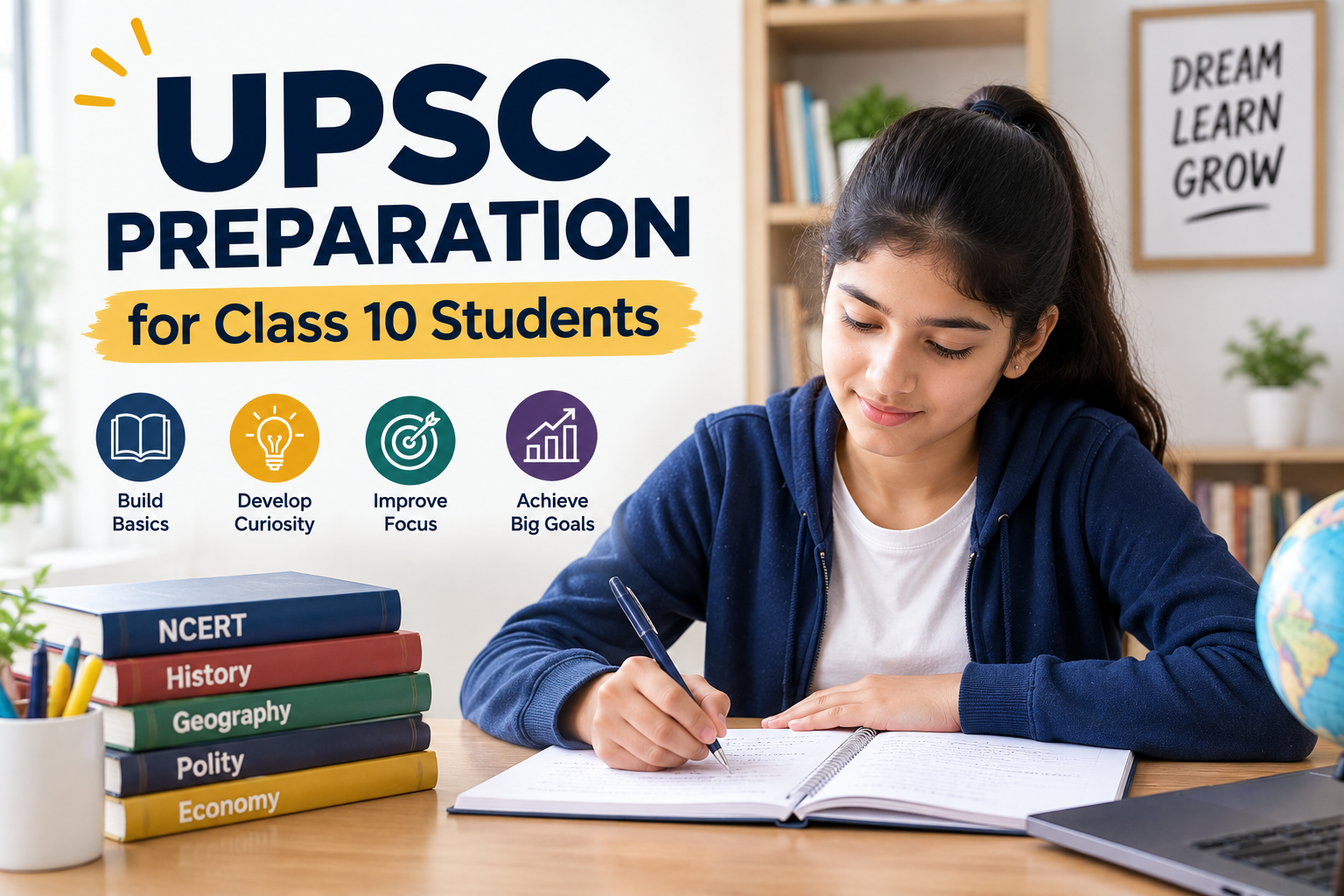
Class 10 is an important stage in a student's academic journey. Students are beginning to think more seriously about their future studies and career choices, and some may already have an interest in civil services. For students who are curious about becoming an IAS officer or pursuing public service in the future, Class 10 can be a useful stage to begin building a strong foundation for UPSC preparation.
However, UPSC preparation for a Class 10 student should not be the same as preparation for a graduate. The UPSC Civil Services Examination requires extensive knowledge, mature understanding and sustained preparation. A school student does not need to complete the entire UPSC syllabus at this stage. Instead, the focus should be on developing the habits and skills that will become valuable during serious preparation later.
One of the most useful habits to develop is regular reading. Class 10 students can gradually begin reading newspapers, reliable news sources, books and articles related to India and the world. The objective is not to memorize every piece of information. Students should learn to understand events and ask questions about why something happened, how it affects people and what possible solutions may exist.
Current affairs can become a regular part of learning at this stage. Students can follow important developments in Kerala, India and the world and discuss them with teachers, parents or classmates. Topics such as government policies, environment, science and technology, the economy, international relations and social issues can help students become more aware of the society around them.
Another important area is general knowledge and awareness of India. Students can gradually become familiar with the Indian Constitution, Parliament, government institutions, geography, history and important national developments. This does not mean memorizing large amounts of information. Understanding basic concepts is more important. When these subjects appear again during higher education and UPSC preparation, students may already have a foundation to build upon.
Analytical thinking is particularly valuable for students interested in civil services. Instead of simply accepting information, students can learn to examine different sides of an issue. For example, when discussing an environmental problem, they can consider its causes, its impact on different groups and possible solutions. This type of thinking encourages students to move beyond memorization and develop the ability to understand complex issues.
Reasoning skills can also be developed through puzzles, logical questions, discussions and problem-solving activities. These activities can make students more comfortable with analysing information and reaching conclusions. Such skills are useful across academic subjects and competitive examinations, not only UPSC.
Writing should also be introduced gradually. A Class 10 student does not need to start writing lengthy UPSC Mains answers. Instead, students can practice writing short explanations, summaries and opinions about topics they have read. They can learn to organize their thoughts, support an idea with examples and communicate clearly. These basic writing habits can later support more advanced answer writing.
Communication and public speaking are equally important. Students can participate in discussions, presentations, debates and speaking activities to improve their ability to express ideas confidently. Learning how to listen to another viewpoint, respond thoughtfully and explain an argument clearly can contribute to both academic development and future civil services preparation.
Time management becomes especially important in Class 10 because students need to balance school subjects, examinations, activities and personal interests. Early UPSC preparation should never come at the cost of school education. A sensible foundation programme should fit around the student's academic schedule rather than creating unnecessary pressure.
Consistency is more important than the number of hours spent studying. A student might spend a small amount of time each week reading current affairs, discussing important issues, practising reasoning questions or improving communication skills. Over several years, these small habits can develop into a strong foundation.
Parents also have an important role in supporting early preparation. Rather than putting pressure on a student to become an IAS officer, parents can encourage curiosity and independent learning. They can discuss news and social issues with their children, encourage reading and provide opportunities for students to speak, ask questions and form their own opinions.
For students who are interested in both UPSC and KPSC, early awareness can also be useful. Many foundational skills such as general knowledge, current affairs, reasoning, reading and communication are relevant to different competitive examinations. The goal at school level should therefore be to build broad abilities rather than narrowly preparing for one examination.
At Compass IAS, the IAS @ School programme is designed to introduce students from Class 8 to 12 to this kind of foundation-based learning. The programme is fully online and combines current affairs, UPSC and KPSC-oriented subjects, general knowledge, reasoning, critical and analytical thinking, reading, writing, public speaking, debate, communication and mentoring. The programme follows a school-friendly approach so that students can continue their regular education without unnecessary interference.
For a Class 10 student, UPSC preparation should therefore be viewed as foundation building. Develop the habit of reading. Understand current affairs instead of simply memorizing them. Strengthen reasoning and analytical thinking. Practise writing and speaking. Learn about India and its institutions. Most importantly, remain consistent without allowing early preparation to become a source of academic pressure.
Starting early can provide an advantage when it is approached thoughtfully. A student who spends the school years becoming more curious, informed, analytical and confident may enter higher education with skills that can later support serious civil services preparation. The objective is not to rush the UPSC journey, but to build a stronger foundation for it.