Why Current Affairs Matter for School Students
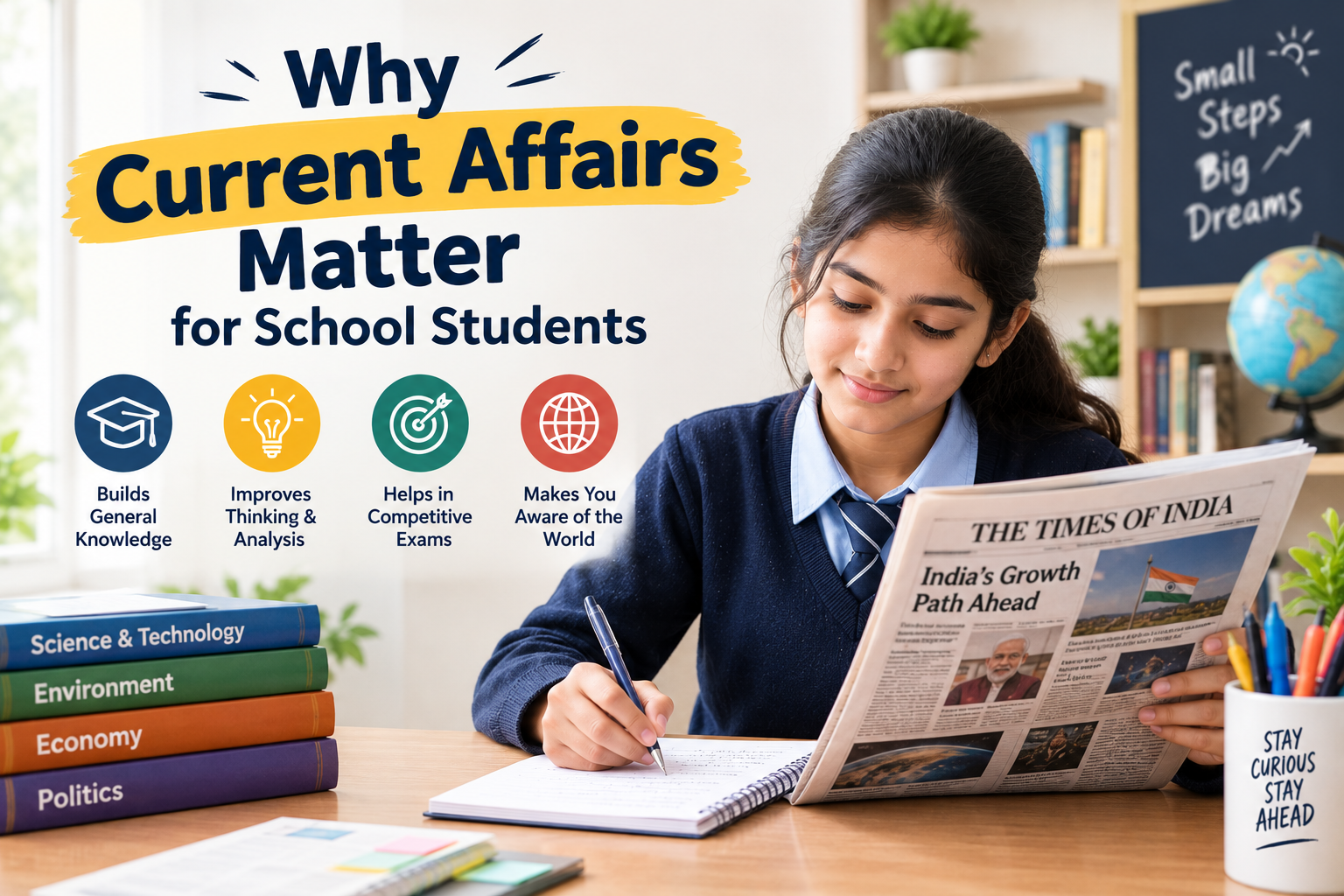
Current affairs are often associated with competitive examinations such as UPSC and KPSC, but their value begins much earlier. For school students, following important events can help them understand the world beyond textbooks, develop curiosity and learn to think about issues from different perspectives. The goal at this stage is not to memorize hundreds of facts. It is to develop the habit of understanding what is happening and why it matters.
A student who regularly follows age-appropriate news gradually becomes more aware of society, government, science, technology, the environment, the economy and events around the world. Instead of seeing these subjects as separate chapters in a textbook, students begin to understand how they are connected to everyday life.
One of the biggest benefits of current affairs is improved general awareness. Students encounter topics such as elections, government programmes, environmental challenges, space missions, scientific discoveries, important national events and developments in Kerala. When these topics are discussed regularly, students become more comfortable with the world around them.
However, current affairs should not become a memorization exercise. A school student does not need to remember every date, name or statistic appearing in the news. A better approach is to ask simple questions: What happened? Why did it happen? Who is affected? What could be the consequences? Is there more than one point of view?
This habit of questioning develops analytical thinking. For example, if students read about a new environmental policy, they can think about why the policy was introduced, what problem it is trying to solve and how it might affect different groups. They are not simply collecting information; they are learning how to examine information.
Current affairs can also strengthen reading habits. Newspapers and reliable news sources expose students to different styles of writing and introduce vocabulary that may not appear in school textbooks. Students gradually become better at identifying the main point of an article, separating important information from unnecessary details and summarising what they have read.
The benefits also extend to communication skills. A student who regularly discusses current events has more opportunities to express opinions, explain ideas and listen to different viewpoints. Classroom discussions, quizzes, debates and short presentations can turn news into an active learning experience rather than passive reading.
For students interested in civil services, this foundation becomes particularly useful over time. UPSC and KPSC preparation requires an understanding of society, governance, economics, history, geography, science, environment and contemporary issues. Building the habit of connecting news with basic concepts during school years can make these areas more familiar later.
At the same time, school students should not be expected to prepare for competitive examinations in the same way as graduates. The purpose of current-affairs learning at this stage is to build awareness and thinking skills while keeping regular school education as the priority. Students should not feel that they need to spend hours every day reading complicated newspapers or memorising examination-oriented material.
A practical routine can be simple. Students can spend a limited amount of time each week looking at important national, Kerala and international developments. They can choose two or three meaningful topics and try to understand them rather than attempting to cover everything. They can then write a few sentences about what they learned or discuss the topic with a parent, teacher or mentor.
Parents can support this process by encouraging questions instead of expecting students to memorise answers. A simple conversation about why a particular event matters can be more valuable than asking a child to remember a list of facts. The objective is to make learning interesting and sustainable.
At Compass IAS Academy, the IAS @ School programme approaches current affairs as part of a broader foundation for students from Class 8 to 12. Along with current affairs, students work on reading, writing, general knowledge, reasoning, critical and analytical thinking, public speaking, discussions, debates and communication. Regular mentoring and activities help students move from simply knowing information to understanding and discussing it.
The most important outcome is not how many current-affairs questions a student can answer today. It is whether the student develops the habit of asking questions, understanding issues and staying curious about the world. These qualities are useful not only for future UPSC or KPSC preparation, but also for academic learning, communication and responsible participation in society.
For school students, current affairs should therefore be viewed as a window to the real world. With the right approach, a few meaningful news stories each week can become opportunities to read better, think more deeply, communicate clearly and understand how the world around them works